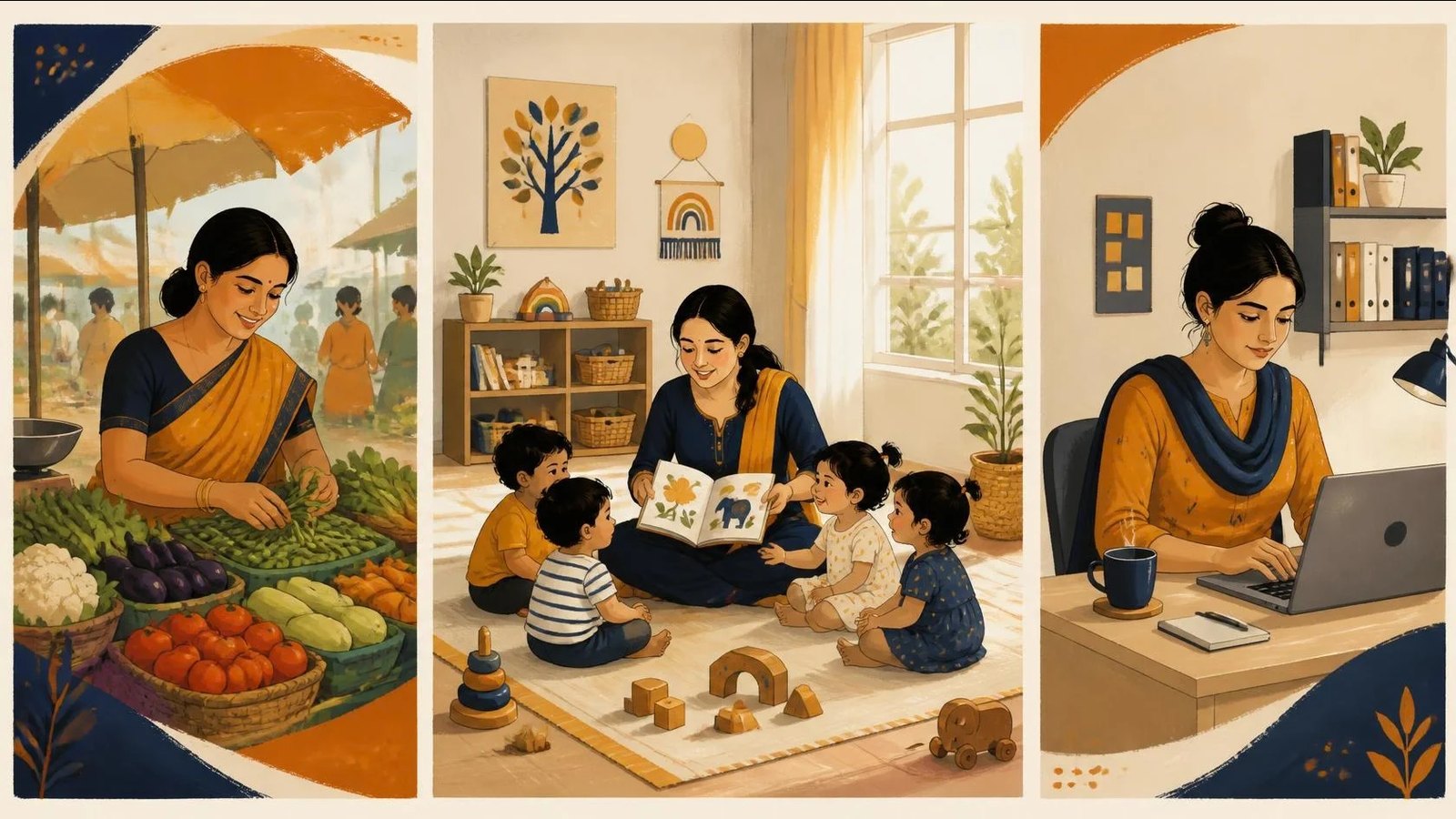
In 2024, on a field visit in Kolkata with SEWA Bharat, part of the Self-Employed Women's Association (SEWA) movement of women working in India's informal economy, I met young mothers who earned their living as waste pickers. Staying at home after a birth was not an option for them. If they did not work, the family did not eat. So their babies and toddlers came along, and the mothers worked with one eye on the job and the other on a child wandering across ground littered with broken glass. They knew the danger. They had no choice, so they worked and worried at once.
The second mother may be sitting in an office, with a salary, paid maternity leave and a childcare policy in her company handbook. Yet in a 2024 Aon survey of nearly 24,000 women in Indian companies, three in four mothers said maternity leave had set their careers back by one to two years.
We rarely talk about these two women in the same breath. We should.
Both are paying, in safety, income or promotion, for care that India still treats as a mother's private problem.
The same missing thing
The numbers are familiar, so I will be brief. Women who do housework spend nearly five hours a day on it, against about an hour and a half for men. Only 40 per cent of women aged 15 and above are working or looking for work, against 79 per cent of men, and in 2024 the International Labour Organization (ILO) found that 53 per cent of Indian women are outside the labour force because of care responsibilities.
For the poorest mother, none of this means stopping work. A 2025 study that followed Indian households over time found that poorer mothers were more likely to be working after a birth, not less. I do not read that as good news. It means there is no cushion. What changes is the work she can do: close to home, in broken hours, with a baby beside her, in businesses like making papads (thin, crisp snacks) and pickles at home that need almost no capital and bring in almost none.
For the salaried mother, the law has tried to help and partly backfired. Since 2017, workplaces with 50 or more employees must provide a crèche, a childcare centre at or near the workplace, and eligible women get 26 weeks of paid leave, which for better-paid women the employer funds. When employers alone bear the cost of paid leave, some become more reluctant to hire women of childbearing age. A study of the reform estimated that it reduced employment among women in white-collar jobs by 6 per cent in the first year and 10 per cent over four years, mostly among younger women. Central rules introduced in 2026 now let employers pay an allowance instead of running a crèche, where a recognised union or a majority of staff agree, with a minimum of ₹500 a month per child. In my experience, a decent private crèche costs at least ₹2,000 to ₹3,000. A policy, a handbook and a committee are not a crèche she can actually use.
When care is left to the mother and its cost to the employer alone, women pay twice: once at home, and again at promotion time.
The answer, for both mothers, is the same thing: care they can trust during the hours they work.
What already works
I worked closely with SEWA Bharat for six or seven years, and much of what I know about childcare that works, I learnt from their programmes. SEWA Bharat is an offshoot of SEWA, and the SEWA organisations work in tandem; SEWA has run crèches for its members, all women in informal work, since the 1980s. One mother told SEWA that only after her child joined Sangini, SEWA's community childcare programme, could she sit at her sewing machine and work.
The workplace model is simple. A company provides the space and a modest monthly payment; SEWA Bharat converts the space into a crèche and trains the women who run it on interactive learning and early childhood development. This child-friendly space, and dependable workers trained to handle both the physical and the mental needs of the child, is what makes a mother trust it. A crèche is not just space and food; a child's mind needs stimulating too.
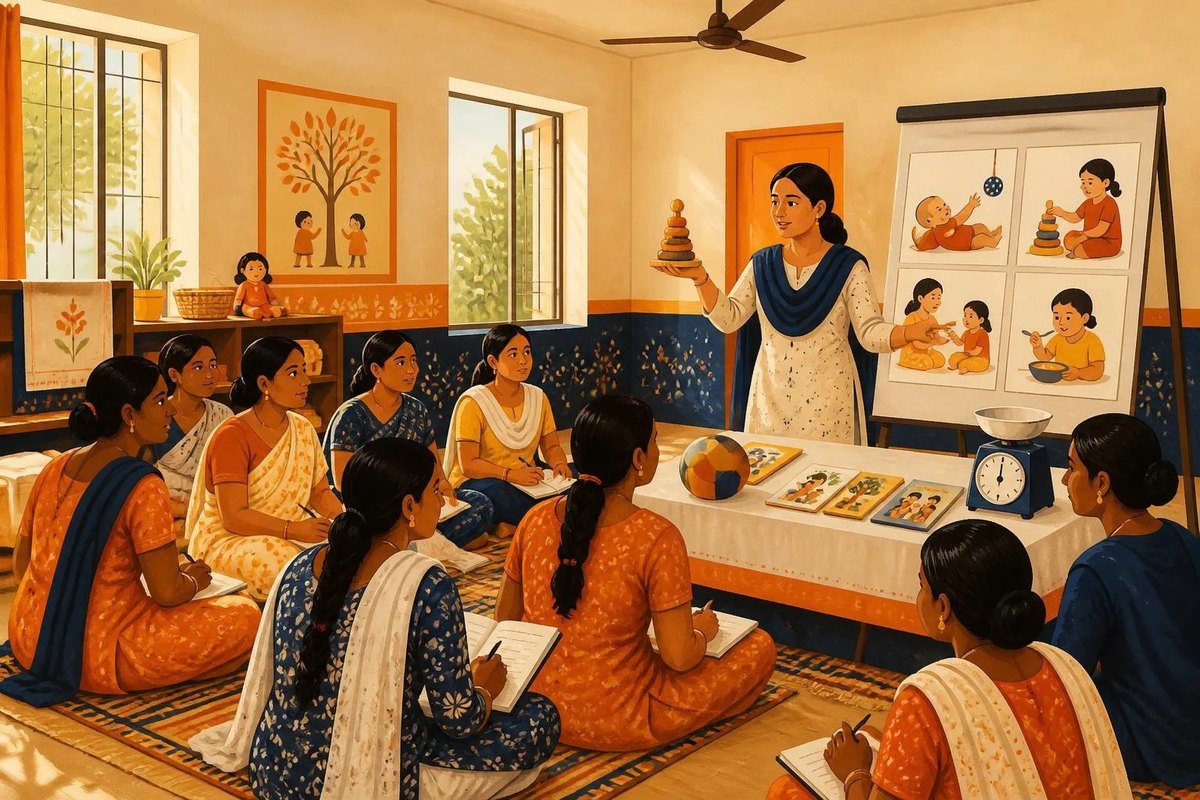
A franchise model, which works in low-income neighbourhoods, was also piloted. Here local women with a room to spare are trained to run small childcare centres from their homes, following SEWA Bharat's standards and with its support, and each is paid a small allowance at the start to set up the crèche as her own business. The franchise crèches provide four to six hours of care close to where mothers live and work, which is what keeps the fee to around ₹600 a month, within reach even for a domestic worker. Even so, fees cover only part of the real cost; donors paid the difference at first, and later corporate and philanthropic supporters helped. The benefit goes to two women: one can go out to earn, and the other is paid to care for children.
The results are measurable. India's Economic Survey for 2023-24 pointed to a study of SEWA's childcare centres in which mothers who used them worked more hours and earned and saved more.
Best practice is not in short supply. Funding is.
We have enough evidence to know that childcare helps mothers work and earn. A World Bank review of 22 rigorous studies from low- and middle-income countries found that all but one showed better employment or earnings for mothers once childcare was available. The harder question is how to provide good care at a price families can afford, and who pays the difference. Two models that have faced that question look very like SEWA Bharat's franchise.
In Kenya, Kidogo finds women already running informal home daycares, trains them in early childhood care and business, and franchises them as "Mamapreneurs". It has franchised more than 530 centres and reaches over 18,000 children a day. In Colombia, a government-supported programme dating back to 1986 uses trained "community mothers" who look after children in their own homes, and public funding has carried it to families across the country.
When I look at these models, five things stand out. The carers are trained and paid. Parents can afford the fee. Someone covers the difference. Quality is checked. And the money does not disappear when one donor leaves.
Where AI fits, and where it does not yet
Honestly, I have not yet seen AI change this work. What I have seen work for mothers is digitisation, backed by financial and digital literacy: a bank account in her own name, and the skills to take payments by phone and sell online.
I can see three areas where AI might help. They are possibilities worth testing, not solutions I have seen working at scale. The first is support for carers, because a mother needs to trust the person looking after her child. Rocket Learning, an Indian nonprofit, has developed Shiksha Saathi with OpenAI, a WhatsApp assistant that answers Anganwadi workers' questions about child development in several languages. Something similar could support a newly trained crèche worker between supervisor visits, though we do not yet know how well it works.
The second is paperwork. Ordinary software can track attendance and fees; AI may help when a woman running a franchise crèche from home can speak to her phone in her own language and get a simple report back to check. The third is knowing where a crèche is needed and whether it can survive. AI could put together how many women in an area go out to work, how many have children under six, what they earn and what care already exists, and show a woman thinking of starting a crèche, or a funder deciding where to put money, which neighbourhoods have enough demand to keep one running. Even where demand is high, families may not be able to pay the full cost, and the same picture would show how much subsidy a neighbourhood needs. It would also tell a cluster of small factories whether a shared crèche would fill. The firms would still have to agree to pay.
There are risks too. A child's records are private, a crèche worker should not have to work under constant digital surveillance, and no mother should be left out because she does not own a smartphone.
AI may help run the back office of a crèche. It cannot hold the baby.
The money is starting to move
Childcare has shifted, in the last five years, from a welfare line to a growth argument. India's Economic Survey for 2023-24 cited estimates that investing 2 per cent of GDP in care services could create 11 million jobs, nearly 70 per cent of them for women. The World Bank launched Invest in Childcare in 2022, with foundation partners committing to help mobilise at least 180 million dollars for childcare in low- and middle-income countries, matched one to one with what a country itself invests; India is already in its policy academy, a programme that helps governments plan childcare policy. The Gates Foundation has funded work to test childcare models that support women's economic opportunities.
Funding lasts when three things can be shown: that childcare helps mothers earn, that the care is good, and that government or another long-term payer will eventually help meet the cost. SEWA's experience, across its organisations, offers the first two. The third is what this article is about.
What it would take
The models and the law exist. What is missing is a fair split of the cost, so that mothers and individual employers are not left to carry it alone.
Employers can treat a crèche as part of how they keep women, and track whether mothers return and get promoted, not just whether leave was granted. Under India's corporate social responsibility (CSR) rules, a company cannot count childcare provided only for its own employees as CSR spending; that is ordinary business cost. CSR funds and philanthropists can instead support community crèches so that fees stay affordable, and for longer than the usual one-year funding cycle, because no crèche is built and trusted in twelve months. Government needs to fund not just the opening of crèches but keeping them staffed, safe and useful, and to pay the women who run them properly.
I think back to the two mothers. One went to work with her child at her feet among the glass, because she had to. The other came back from leave and found the ladder had moved without her. Neither was choosing between work and her child.
A crèche, properly paid for, is how we give them that choice.
Sources
- Aon, Voice of Women study 2024, via Business Standard, 8 August 2024: https://www.business-standard.com/india-news/maternity-penalty-75-mothers-face-career-hurdles-after-leave-report-124081000274_1.html
- Ministry of Statistics, Time Use Survey 2024, factsheet: https://www.mospi.gov.in/sites/default/files/publication_reports/TUS_Factsheet_25022025.pdf
- Ministry of Statistics, Periodic Labour Force Survey, Annual Report 2025: https://pib.gov.in/PressReleasePage.aspx?PRID=2246009
- ILO finding on care responsibilities, as cited in IWWAGE, Women and Work: How India Fared in 2024: https://iwwage.org/wp-content/uploads/2026/02/Women-and-Work-2024.pdf
- Banerjee, Mukhopadhyay and Jaiswal, Motherhood and Labour Market Outcomes: Penalty or Premium?, IZA Discussion Paper 18246, 2025: https://www.iza.org/publications/dp/18246/motherhood-and-labour-market-outcomes-penalty-or-premium
- Ghosh, Hao, Ho, Sharma and Tandon, The Effects of Mandated Maternity Leave on Labour Market Outcomes in India, summarised on VoxDev, April 2026: https://voxdev.org/topic/labour-markets/women-india-valued-longer-maternity-leave-it-cost-them-jobs
- Social Security (Central) Rules, 2026, crèche provisions, summarised by Lakshmikumaran and Sridharan: https://employmentlaw.lkslaw.com/creche-facility-employer-obligations
- SEWA Bank, loan products: https://sewa.bank.in/loans
- Economic Survey 2023-24 on the care economy, via Deccan Herald, 22 July 2024: https://www.deccanherald.com/business/union-budget/union-budget-2024-survey-calls-for-strategic-reforms-in-care-as-india-faces-motherhood-penalty-3116719
- World Bank, Childcare and Women's Labor Market Outcomes in Lower- and Middle-Income Countries, 2022: https://openknowledge.worldbank.org/bitstreams/409a2738-c6d3-5ec4-99db-e3a4cc852ba3/download
- Kidogo, Kenya, via Cartier Philanthropy: https://cartierphilanthropy.org/partnerships/kidogo-quality-childcare-in-kenya-s-slums
- UNICEF Innocenti, Home-Based Community Day Care and Children's Rights: The Colombian Case, 1993: https://ideas.repec.org/p/ucf/iopcrs/iopcrs93-6.html
- Palna approvals, Rajya Sabha reply, July 2025: https://www.sakshipost.com/news/centre-approves-14599-anganwadi-cum-creches-under-palna-scheme-432310
- Palna operational centres as on 31 March 2026, Ministry of Women and Child Development: https://wcd.gov.in/offerings/palna
- UNICEF, India country profile, annual births: https://data.unicef.org/wp-content/uploads/country_profiles/India/country%20profile_IND.pdf
- Rocket Learning, Shiksha Saathi: https://rocketlearning.org/shiksha-saathi/
- World Bank, Invest in Childcare, launch April 2022: https://www.worldbank.org/en/news/press-release/2022/04/28/world-bank-partners-launch-new-fund-to-spur-smart-investments-in-childcare
- Gates Foundation Grand Challenges, Strengthening Childcare Models that Advance Women's Economic Power: https://gcgh.grandchallenges.org/challenge/strengthening-childcare-models-advance-womens-economic-power
About the author

Dr Sharmila Neogi is an obstetrician and gynaecologist with more than twenty-five years in programme design, planning and implementation. At USAID India she advised on maternal and child health, family planning, adolescent health and gender. She worked closely with SEWA Bharat for several years on women's economic empowerment, entrepreneurship and childcare. She is now a freelance consultant advising on women's health, gender, mental health and youth development.
Editor's Note · KairoPact
KairoPact is building a global initiative that brings women's livelihoods, childcare and health together into one programme, because difficulty in one holds back progress in the others and a woman's income depends on all three. If you fund or run work on women's livelihoods, childcare or women's health, and would like to help shape it, write to us at connect@kairopact.com.